Know what you're reading
How to read product testing and ingredient information
Learn to read pet-product labels and batch-specific COAs: identity, amount, purity, contamination checks, laboratory scope, storage evidence and limits.
Updated
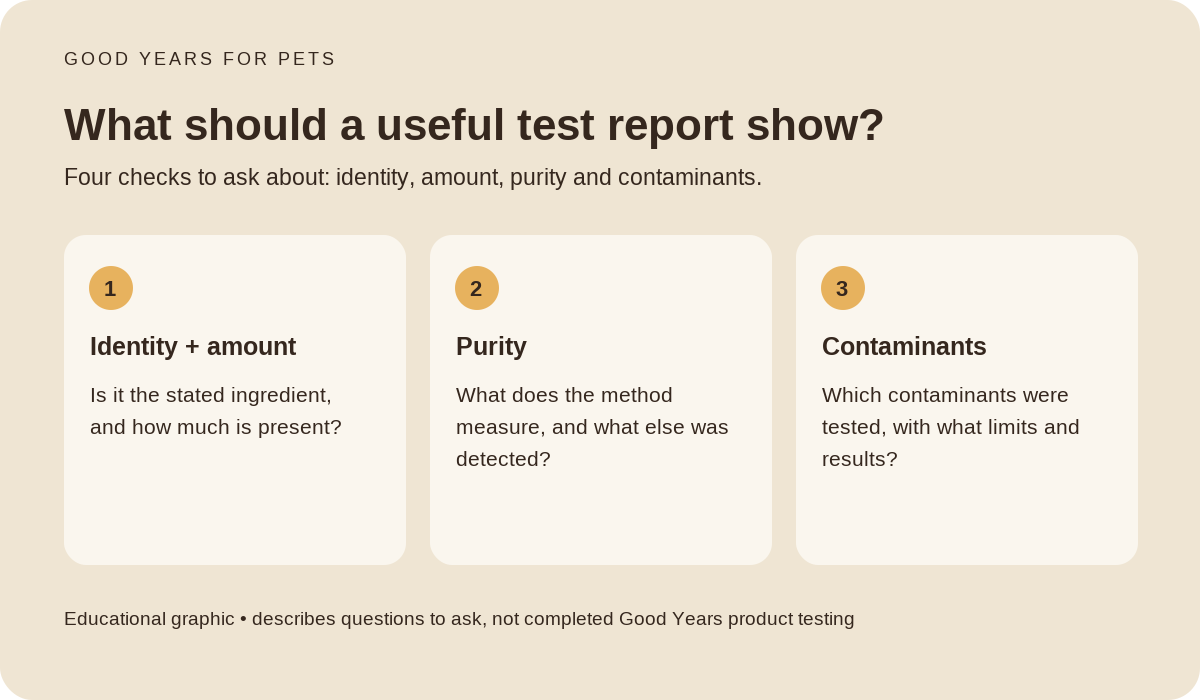
Four different questions.
Identity asks what the ingredient is. Amount asks how much is present. Purity asks what the method measures. Contaminant testing asks which unwanted substances were checked.
A report answers only the questions it actually tested. This is a reading guide, not evidence of completed Puppy at Heart product testing.
Open the full-size diagramStart with what is in the product, which batch was tested and what the laboratory measured. Clear answers give you something useful to bring to your veterinarian, and you do not need a chemistry background to begin asking good questions.
This guide walks through labels and certificates of analysis, or COAs, one part at a time. Puppy at Heart is a pet-health brand with an oral BPC-157 product for dogs and has a commercial interest in the subject. Product-specific Puppy at Heart results are not presented here.
Sources checked: October 26, 2026.
Start with the label
Keep the label and testing report together. Ask what exact ingredient form is listed, what other ingredients are present, how much is stated per unit and which lot the container belongs to. For a blend, check whether the amount of each ingredient is disclosed or only a combined total.
For BPC-157, ingredient identity includes the actual form being supplied. FDA's assessment separately considered BPC-157 free base and acetate and examined gaps in characterization and impurity information. That assessment does not validate a pet product or establish that one form has a proven advantage for dogs. FDA substance and quality discussion, printed pp.9–22.
A labeled amount per capsule, chew or measured serving is a product statement. It is not, by itself, evidence that the amount is appropriate treatment for a dog. The dosage evidence guide explains that distinction.
Read the certificate of analysis
A certificate of analysis, or COA, records specified analyses for an identified material or batch. Read its scope before relying on its conclusion. These questions help connect the document to what is actually offered:
| Check | Questions to ask |
|---|---|
| Material and lot | Does the document name the material and exact form? Does the lot match the offered product, or is there a documented link between ingredient and finished-product lots? |
| Sample stage | Was the sample a raw ingredient, a manufacturing blend or the finished packaged product? |
| Laboratory and report | Who performed the analysis? Is there a report identifier and a way to establish that the document is authentic? Who issued or authorized it? |
| Dates | When was the sample tested and the report issued? Are release, expiry or retest dates clearly identified where relevant? |
| Methods | Which method was used for each test, and is it suitable for the substance and formulation being tested? |
| Results and units | Does each result have units where needed, rather than only a general "pass"? What acceptance limit was used? |
| Scope of checks | Which impurities or contaminants were actually assessed, and what was outside the testing scope? |
| Revisions | Is this the current report? If a document was replaced, can the reason and connection to the original batch be explained? |
The field questions draw on FDA's Q7 certificate-of-analysis guidance, §§11.40–11.44 and the BPC-157 quality assessment. Q7 concerns active pharmaceutical ingredients for human medicines. Here, it provides a reference for reading document fields. It does not determine which requirements apply to a particular pet product.
If a report is reissued by a distributor, ask how it connects to the original material, manufacturer and analysis. A document for a different lot should not silently substitute for the lot being offered.
Separate identity, amount, purity and contamination checks
| Question | What the relevant test information addresses | The next question to ask |
|---|---|---|
| Identity | Whether the tested material matches the substance the method is intended to identify. | How much is in the finished serving, and which clinical evidence is relevant? |
| Amount or content | How much of the measured ingredient is in the tested sample, in stated units. | What clinical evidence supports that amount for the proposed use? |
| Purity and related substances | What the specified method reports about the main material and measured impurities. | Which other quality checks and finished-serving measurements were performed? |
| Microbial or chemical contamination | Results for the organisms or substances actually included in the panel, with the method and limits. | Which organisms or substances were included, and what were the detection or acceptance limits? |
FDA's BPC-157 review identifies limitations in certificates that supply purity results without adequate identity, impurity or other quality information. It also distinguishes characterization from pharmacokinetic, safety and clinical evaluation. FDA assessment, quality sections.
If a document uses "potency," ask what that term means on that report, what was measured and in which units. Do not read it as a clinical outcome. Likewise, a purity percentage is not automatically the amount per capsule or chew.
Testing scope depends on the material, formulation and intended route. A panel designed for an injectable preparation should not be presented as a universal checklist for every oral product, and an oral-product panel does not establish injectable quality. Ask for the reason each test and limit was selected. The panel and limits need to fit the actual material, formulation and route.
Check what was sampled and who tested it
An ingredient report answers questions about that ingredient sample. It does not automatically describe the product after blending, filling, packaging or storage. Ask which finished-product checks were performed and how the lot records connect. FDA explicitly notes that changes in formulation and production mean evidence for one finished product cannot simply be transferred to another. FDA veterinary-compounding Q&A, question 2.
"Third-party tested" still needs detail. Ask which laboratory did what, who selected and submitted the sample, and whether the report concerns the actual product and batch. The phrase alone does not answer those questions.
If laboratory accreditation is claimed, check the current certificate and its scope for the relevant tests. NIST explains that laboratory accreditation concerns competence for specified tests or calibrations. Its NVLAP program does not certify products or test data. Accreditation is not evidence that a pet product is clinically effective or FDA-approved. NIST explanation.
Read storage and shelf-life support
A release-day result and a shelf-life claim answer different questions. Ask what data support the labeled storage conditions and the period during which the finished product is expected to remain within its stated specifications. Clarify what a retest date or expiry date refers to, especially if the document is for a raw ingredient.
FDA's API guidance connects storage and dating to stability evidence, while its BPC-157 assessment discusses formulation-related stability concerns. Neither supplies a universal storage temperature or shelf life for all pet BPC-157 products. Q7, §§11.50–11.61; BPC-157 stability discussion, printed p.14.
Connect testing with clinical evidence
An analytical report helps characterize the tested sample. To understand oral absorption, benefit, medicine compatibility or long-term safety, look alongside it for appropriate biological or clinical studies of the relevant route, formulation and population.
For BPC-157, the research library separates injection exposure studies, toxicology and uncontrolled clinical observations. The oral guide explains absorption versus outcomes, and the safety guide describes observed findings and unresolved risks. A well-documented sample is not a substitute for those questions.
Documents and follow-up questions
Keep the label, matching report and source links together. Any product-specific claim should be read with the authentic records and the scope of the actual tests.
If information is missing or inconsistent, note the product name, lot, report identifier and date, then ask the supplier for clarification. Keep the label and documents for your veterinarian. A testing badge should never replace the underlying scope and results.
Get product updates
Join the dog launch waitlist to receive product news and availability updates for our first dog product. There is no purchase commitment or promised launch date.
Get product updates
The evidence pages remain available without signing up.