The Puppy at Heart reading room
BPC-157 for Dogs: An Owner’s Guide
You know your dog’s version of a good day. The walk they don’t want to end. The toy they still bring you. The spot on the sofa they’ve claimed for years.
BPC-157 is a peptide that researchers have studied for more than 30 years, mostly for how muscle, tendon and gut tissue recover. Owners of older dogs ask about it because those are the things that change as a dog ages. This guide covers what it is, what the research has found and what is still open.
Explore the researchold dog. young soul.
The ingredient
What BPC-157 is
BPC-157 is a peptide, a short chain of 15 amino acids that is part of a larger naturally produced compound in human and dog stomachs. It has been around for over 30 years and over the last 10–15 years has become one of the most viral and anecdotally popular compounds in the fitness, biohacking and longevity communities.
Most studies look at how tendon, ligament, muscle and gut tissue recover in laboratory animals.
At a glance
- What it is
- A peptide: a short chain of 15 amino acids
- First published research
- 1993
- Where most research is
- Laboratory animals, mostly rats
- In Rewind
- 150, 300, 500 mcg per capsule, by dog size
The research so far
What researchers are exploring
Three questions come up most. Here is one finding for each, with who was studied and how it was given.
Movement and tissue recovery
Most BPC-157 studies ask how tendons, ligaments and muscles recover after an injury. Researchers usually measure two things together: how well the animal moves, and what the repaired tissue looks like. So far this work is in rats.
More movement and recovery studiesRead about BPC-157 and arthritis in dogsTrack your senior dog’s mobilityRat study
Rats given BPC-157 by mouth walked better after a serious muscle injury
Researchers surgically detached the thigh muscle from the bone in rats, then gave BPC-157 in their drinking water. Treated rats walked better. At three months, MRI showed no gap left between muscle and bone, while a gap remained in untreated rats.
- Studied in
- Rats
- How it was given
- By mouth, in drinking water
- Type of study
- Controlled experiment with random allocation
Gut health
The gut is where the BPC-157 story started. Researchers have looked at whether it protects the stomach and gut lining from ulcers and from damage caused by medication.
More on gut health researchRat study
BPC-157 protected the stomach lining from medication damage in rats
Clopidogrel, an anti-clotting medication, made healed stomach ulcers come back in rats. In rats that also received BPC-157, ulcers returned in 2 of 10 instead of 6 of 10, and the damage was milder.
- Studied in
- Rats
- How it was given
- Daily injection into the abdomen
- Type of study
- Controlled experiment with random allocation
Safety
Safety has been tested in short laboratory studies in mice, rats, rabbits and dogs, and the published results are encouraging. Daily use by mouth over months in older dogs has not been studied yet, so our safety guide walks through what is known and what to ask.
More on the safety researchRead the safety guideSafety testing
Safety testing in four species reported that BPC-157 was well tolerated
Researchers ran single-dose and repeated-dose safety tests in mice, rats, rabbits and dogs. They reported no serious toxicity. In dogs, creatinine was lower at the highest dose and returned to normal within two weeks after dosing stopped.
- Studied in
- Mice, rats, rabbits and beagles
- How it was given
- Muscle injection in the dog tests
- Type of study
- Laboratory safety testing with a control group
Closer to home
What has been observed in dogs
There are two kinds of dog evidence here, and they are different things: reports published in journals, and what owners tell us.
In the journals
Dog study
Six beagles tolerated BPC-157 injections with no visible signs of toxicity
Researchers gave six young beagles BPC-157 by injection into a vein or a muscle, including seven days of daily injections, and measured how much reached the blood. They reported that the injections were well tolerated. Blood levels fell by half in under 30 minutes.
- Studied in
- Six beagles, 10 to 12 months old
- How it was given
- Injection into a vein or a muscle
- Type of study
- Blood-level study, no treatment comparison
Veterinary case report
Four dogs with knee problems moved better during care that included BPC-157
A holistic veterinarian, Dr. Shelby Watson, described four pet dogs with knee injuries or degeneration that were treated without surgery. Their mobility and lameness improved during care that included BPC-157 by mouth or by injection.
- Studied in
- Four pet dogs, aged 5 to 11
- How it was given
- By mouth or by injection, depending on the dog
- Type of study
- Case report, no comparison group
From owners
Pippin is a little pug I know here in Austin. Around age nine, she lost the use of her back legs because of IVDD. Within two weeks of starting BPC-157, she began taking steps again. Her steps were choppy, and sometimes she’d fall. She still walks unevenly, but getting in and out of her dog bed is much easier for her now. That’s the part that meant so much to Stephanie, her owner.
What other owners are sharing online
Sometimes you want to read the whole story, including the replies. These discussions are a place to do that. They are self-reports, not verified medical records.
- Peptides for dogsAn owner asks about a dog with digestive problems. A commenter describes improvement in chronic skin symptoms after liquid BPC-157. That outcome comment doesn’t clearly establish the administration route.
- Has anyone here used peptides on a canine?A commenter explicitly describes oral use, but attributes an eye-cloudiness change to separate eye drops. Another describes an injected BPC/TB combination and a limp that later returned. The oral commenter also appears in the thread above, so these aren’t two independent oral success stories.
- BPC-157 for a seven-year-old Labrador with osteoarthritisThis owner describes starting injections. It is useful context for the conversation, but it isn’t an oral-treatment result or a demonstrated recovery.
The research in numbers
More than 30 years of published research
- 230publicationsPubMed-indexed literature about BPC-157
- 165original research papersLaboratory, animal and human research reports
- 30+years of researchPublications spanning 1993–2026
PubMed literature search, November 14, 2026. Publications span 1993–2026 and include laboratory, animal and human research. View the paper list and counting method
Before you decide
Practical questions
Short answers here. Each one links to a guide that goes deeper.
Can BPC-157 be given by mouth?
Yes, and some of the most interesting research gave it that way. In rat studies, BPC-157 in drinking water was followed by better movement and tissue repair in an injured leg, well away from the gut. How much of a swallowed dose reaches a dog’s bloodstream has not been measured yet.
Read the oral research guideIs it safe for my dog?
Short laboratory studies in dogs reported that BPC-157 injections were well tolerated. One set of tests also found changes in some blood measurements, and long-term daily use in older dogs has not been studied. If your dog takes medication or has a diagnosed condition, talk to your vet first.
Read the safety guideHow much did dogs get in the studies?
Published studies report the amounts they used, along with each dog’s weight and how it was given. Those are study amounts, not a recommended dose. Our guide lays them out side by side.
See the study-dose evidenceWhat should I ask my vet?
Bring the label and a full list of what your dog takes now. Mention what has changed in their walking, appetite, sleep or behavior. Our worksheet has questions you can print and take with you.
Get the vet visit worksheetWhat should I look for on a label?
Look for the full ingredient list, the amount of each ingredient, how it is meant to be given, a lot number and testing that matches the finished product.
How to read a label and a test report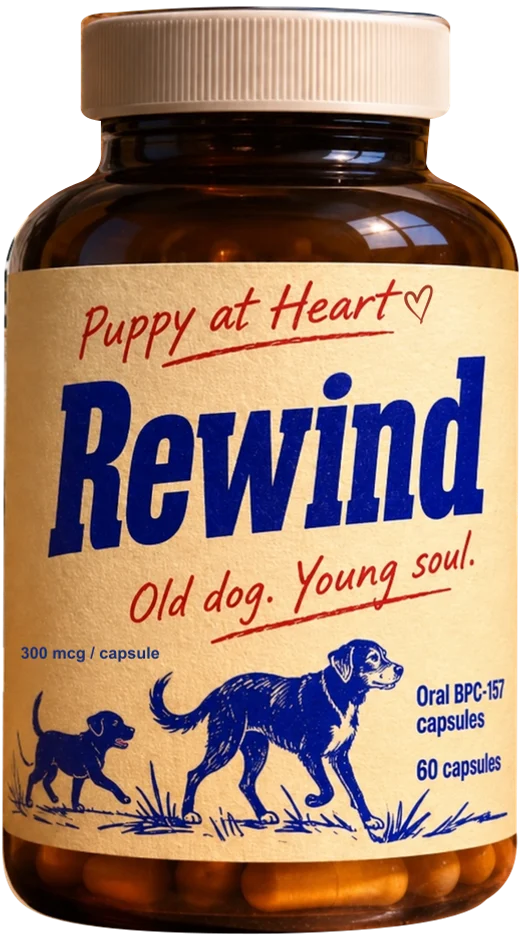
From Puppy at Heart
Oral BPC-157 capsules for older dogs
Rewind is our BPC-157 capsule for older dogs. It comes in three sizes by weight, with 60 capsules per bottle and nothing to inject, measure or mix.
Explore RewindThe studies in this guide are about BPC-157 as an ingredient. None of them tested Rewind itself.